
Traffic is up, the team is shipping, and revenue has been flat for three quarters. The site looks busy and the dashboards look active, but the KPIs that matter to the business aren’t moving even as campaigns ship and tickets close.
Leadership wants answers and asks what’s wrong. The team has theories, but none of them feel right because none of them get to the actual problem.
This is the pattern we see time and time again across the eCommerce brands trying to scale right now. The business is expanding into new markets, customer segments, and channels, but the platform that worked last year is breaking under the weight of what the team is trying to do this year.
Integrations are fragile and workflows are duct-taped together, which means the team is moving fast on top of a stack that’s slowing them down. Brands typically come to us mid-firefight rather than at the start.
The actual problem lives underneath the activity, where your systems are silently suppressing revenue and the leaks are already there. The team has gotten good at working around them, which is why everything feels stable. Growth is going to expose every one of those leaks at once.
Here’s what we’ll address: how systems quietly suppress revenue, why AI can accelerate the suppression instead of fixing it, how we prioritize the work that actually moves the number, and the question worth asking before you spend another quarter pushing on the wrong things.
Why More Work Isn’t Producing More Growth
The traffic side of the business is usually working. What’s hiding underneath is a systems problem showing up as a revenue problem, and the two get mistaken for each other constantly.
Activity across the business is genuinely high. Marketing is running campaigns and products are shipping features. Engineering is closing tickets and customer service is answering questions. Every team has metrics moving in the right direction within their own scope. Add it all up and revenue stays flat because the work isn’t connecting to the outcome.
A few structural reasons show up across the brands we audit:
- Platforms built for last year’s complexity. The stack was put together to serve the business as it existed when the site launched. New integrations got patched in as needs came up. The architecture was never designed to support the markets, channels, and customer segments the business is now trying to reach.
- Fragile front-ends with bloated dependencies. Sites that look modern often execute slowly. Page weight, third-party scripts, and accumulated tech debt create friction the visitor feels. The conversion rate quietly absorbs the cost even when the team can’t see it in the analytics.
- Execution speed dropping while expectations rise. The business needs to move faster to capture the next phase of growth. The systems are making it slower instead. Teams burn capacity working around their own stack, and the workarounds become permanent because nobody has the bandwidth to fix the root cause.
- Friction reaching the customer. When systems are stretched, the friction shows up in checkout, fulfillment, support response times, and the post-purchase experience. The customer feels every one of those touchpoints. The merchant’s reputation pays for it over time.
Baymard Institute’s research across 4,400+ moderated user tests on 325 eCommerce sites found that the average large-scale site has 32 fixable friction points in checkout alone. That represents a documented 35% conversion lift sitting unfixed. The leaks have been measured across hundreds of sites and the fixes are known practice.
AI as an Accelerator
AI keeps getting pitched as the fix for whatever’s slowing growth right now.
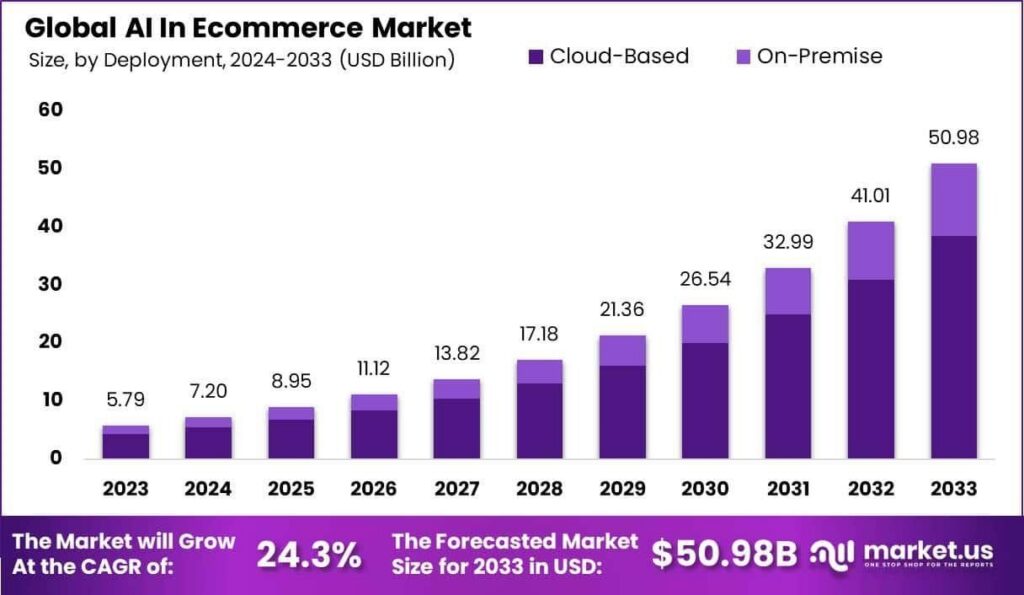
The pitches sound similar across vendors: smarter personalization, faster optimization, better customer experience, all powered by AI. Buyers are being asked to write checks based on the promise that AI will move the conversion number.
The actual mechanics are simpler than the pitch makes them sound. AI is an accelerator. It compounds whatever sits underneath it.
Strong systems get faster and sharper when AI gets added. Here’s what you’ll experience:
- Clean data feeds better personalization.
- Sound workflows automate cleanly.
- Connected systems pass information correctly between tools.
- The team gets capacity back to focus on the work that needs human judgment.
And on the flip side, weak systems get worse faster, such as:
- Messy data feeds wrong recommendations to the wrong customers at higher volume.
- Broken integrations stay broken, but now they break at scale.
- Unclear strategy gets executed sloppily across more touchpoints than before.
- The team spends the capacity AI saves them on cleaning up the new problems AI created.
The deciding factor is the state of the foundation before AI gets layered on. Strategy, data quality, workflow design, and integration health determine whether AI lifts revenue or amplifies the existing problems. None of those four sit inside what AI can fix on its own.
Where we see the biggest gains from AI right now are the brands that did the unglamorous work first — they cleaned the data, simplified the workflows, connected the systems, and clarified the decisions about where the business is heading. AI added speed to a foundation that was already pointed in the right direction.
The Pressure Test
Here’s a question worth sitting with… If your business grew 50% or 100% over the next year, where would your biggest friction come from?
Teams can usually answer right away. They already know which integration is fragile, which workflow depends on one person manually exporting a file every morning, and which part of the checkout flow would buckle if volume doubled. This friction is rarely a mystery; it lives in plain sight, and people on the team have named it in passing more than once.
What keeps it in place is normalization. The workarounds became routine, and that routine started to feel like the system working as intended:
- Inventory gets reconciled by hand every day, so the numbers always look fine
- Failed orders get caught before they turn into support tickets, so the order flow looks healthy
- Slow pages get blamed on traffic spikes, so the performance problem never gets a real diagnosis
That daily compensation hides the cracks well enough that the problem stops registering as a problem.
Growth removes the compensation. Manual reconciliation that worked at 1,000 orders a day falls apart at 2,500, and whoever was catching failed orders can no longer keep up. A checkout flow that is held at current traffic starts dropping conversions during the exact moment the business is trying to scale. Then revenue, customer experience, and team capacity crack at the same time, which is usually during the season when the business can least afford it.
Fixing the foundation before growth exposes it is the work worth doing now. Brands that pressure-test their systems ahead of a growth push tend to scale cleanly. Skip that step, and the growth phase gets spent on crisis management instead.
How Bighorn Prioritizes the Work
Naming the leaks is the easy part. Once a team starts looking, the list gets long fast: Heatmap insights, A/B test backlogs, CRO recommendations from two or three different vendors, integration tickets, performance fixes, and AI experiments to run. eCommerce teams are rarely short on ideas. They’re short on a way to decide which ideas matter most and will bridge the gap between systems and revenue growth.
That decision is where most of the value gets won or lost. A backlog of 50 improvements treated as equally important is a backlog that moves slowly and shows little for the effort. The same 50 items ranked by revenue impact become a roadmap that compounds.
We weigh every recommendation against two questions. How much revenue does this unblock, and how confident are we in the lift? Those two answers sort the work quickly:
- High impact, high confidence work goes first, especially anything touching high-traffic, high-intent paths like checkout, product pages, and the steps right before purchase
- High impact, lower confidence work gets tested before it gets built, so a big bet gets validated cheaply before it gets expensive
- Low impact work waits, regardless of how interesting it looks or how loudly someone is asking for it
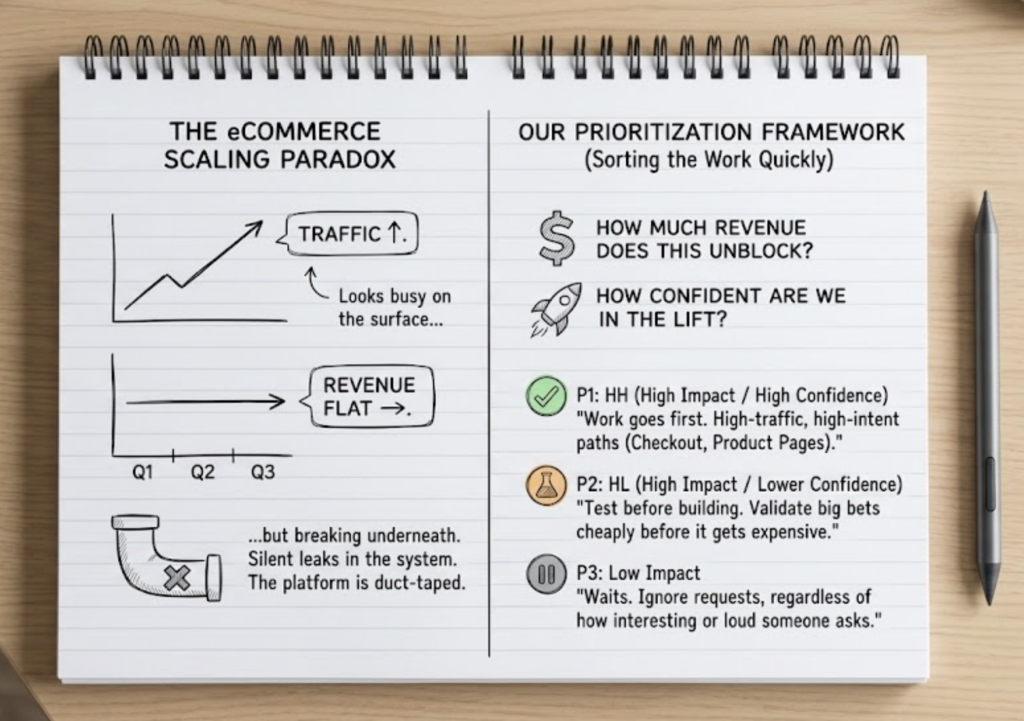
The paths closest to the money get attention first because a small percentage gain on a high-traffic checkout flow is worth more than a large gain on a page almost nobody visits.
That sounds obvious written down, yet plenty of backlogs still get sorted by who asked loudest or what’s easiest to ship, rather than by what moves revenue.
Prioritizing this way turns a long backlog into actual revenue growth instead of motion. If you want a clearer view of where your systems are creating revenue friction, let’s walk through it together in a 20-minute feedback session.