
Peak season is a handful of weeks that decide a big share of the year. Traffic climbs, orders surge, and the margin for error drops to almost nothing. Everything that runs fine the rest of the year gets tested at three or four times the load, all at once, on the days the business can least afford a problem.
The failure every ecommerce director dreads is the one that never showed up in testing. The site held during the load test, the team checked the boxes, and then the biggest sale day of the year arrives and something buckles that nobody thought to check. It might be an oversell on a product that was supposed to be in stock, a data sync that falls behind and leaves orders stuck, or a promotion that misfires across the entire catalog. By the time anyone catches it, the revenue is already gone.
A lot of peak-season prep goes into the storefront, covering site speed, load testing, and keeping the site up. That work is necessary and it still leaves the riskiest part untested. The failures that cost the most revenue during peak tend to sit deeper in the operation and in the systems that move an order after the customer clicks buy.
Here’s what we’ll cover:
- why storefront readiness is only part of the picture,
- where the operational risks actually hide,
- and a cross-functional checklist you can run against your own operation before the season hits.
Let’s dive in!
Why Storefront Readiness Is Only Part of the Picture
The storefront work is real, and every team should do it. Load testing at realistic peak multiples, a properly configured CDN, caching that holds up, uptime monitoring, and a checkout flow that’s been tested under pressure all keep the site standing when traffic spikes. A site that goes down on the biggest day of the year is the most visible failure there is, so this work gets the attention it deserves.
The problem is where the attention stops. Storefront readiness confirms that the site can take the traffic. It says nothing about what happens to an order once the customer places it. That handoff, from the storefront to the systems that actually fulfill the order, is where peak-season revenue tends to leak, and it’s the part most readiness plans barely touch.
Think about the path a single order takes on a peak day. The customer checks out, and the order needs to reach the ERP, decrement inventory, trigger fulfillment, apply the right promotion, and reconcile against payment and tax. Each of those steps depends on systems talking to each other cleanly at a volume they rarely see the rest of the year. The storefront can be flawless and the order can still stall, oversell, or misprice somewhere downstream.
Readiness has to cover the whole path, from the first page load to the moment the order is fulfilled and reconciled. The sections below walk through the operational risks that live in that downstream stretch, starting with the two that do the most damage: inventory and ERP synchronization, and promotion and pricing logic.
Inventory Accuracy and ERP Synchronization Risks
The most expensive peak-season failures usually trace back to inventory and the systems that keep it accurate. These risks stay invisible at normal volume and surface the moment order rates climb.
- Inventory that falls behind at volume. A sync that runs comfortably at your usual order rate can fall behind when volume jumps to three or four times normal. While it catches up, the site keeps selling from numbers that are already stale. The result is overselling products that are no longer available, which turns into cancellations, refunds, and apology emails during the exact window when you’re trying to win new customers. Every oversell is a sale reversed and a first impression wasted.
- ERP integrations buckling under order volume. Order data that flows cleanly at normal load can queue, lag, or error when the volume surges. Orders start backing up between the storefront and the back office, and fulfillment falls behind before anyone realizes the integration is the bottleneck. On a normal day the lag is invisible. On the biggest day of the year it compounds hour over hour until the operation is buried.
- Manual workarounds that collapse under load. Every team leans on a few manual steps to keep things moving, and those steps work fine at normal volume. When orders triple, the person who reconciles inventory by hand or clears stuck orders every morning cannot keep pace. Anything in the operation that depends on a human doing it manually becomes a chokepoint the moment volume spikes, and peak season is when every chokepoint gets found.
The pattern across all three is the same. These systems perform well enough that they never get stress-tested at true peak load, so the weakness stays hidden until the season exposes it.
Pressure-testing inventory sync and ERP integration at realistic peak multiples, well before the season, is what separates the teams that stay standing from the teams that spend their biggest weekend firefighting.
Promotion, Pricing, and Merchandising Bottlenecks
The second cluster of risk sits closest to the revenue moment itself. Peak season runs on promotions, and the systems behind those promotions are the ones under the most strain when the discounts go live and the traffic peaks together.
- Promotion logic that breaks at scale. A discount rule that behaves perfectly on a handful of test products can misfire once it’s applied across an entire catalog on the busiest sale day. The rule might fail to apply where it should, stack with another promotion in a way nobody intended, or quietly erode margin across thousands of SKUs before anyone notices the numbers are off. The bigger the catalog and the bigger the sale, the more room there is for the logic to break somewhere you weren’t watching.
- Pricing updates that can’t move fast enough. Peak season is the most competitive pricing window of the year, and it rewards teams that can react in hours. When a price change has to travel through slow manual steps or a fragile integration, the team loses the ability to respond to a competitor’s move or an inventory position in real time. The price you set on Tuesday is stuck until someone can push the change, and during peak that lag costs sales.
- Merchandising cycles too slow for the moment. Peak season is won in short windows. A hero product sells out and needs replacing, a category catches fire and deserves the homepage, a promotion needs to launch the moment a competitor blinks. When updating the catalog or swapping merchandising takes days instead of minutes, the team watches those windows close before they can act on them.
The through-line here is speed. Promotion, pricing, and merchandising all depend on the team’s ability to make a change and have it take effect quickly and correctly across every system that touches it.
When the systems underneath are slow or fragile, the team loses the responsiveness that peak season demands, and the revenue that responsiveness would have captured goes uncaptured.
The Cross-Functional Peak Season Readiness Checklist
Readiness isn’t one team’s job. The storefront, the operations side, and the merchandising team each own a piece, and the failures usually happen in the seams between them. The checklist below is organized by area so each team knows what it owns, with a final section on the cross-team coordination that ties it all together.
Run this against your own operation while there’s still time to fix what it surfaces.
Storefront
- Load testing done at realistic peak multiples, not just a modest bump over normal traffic
- CDN and caching configured and verified under load
- Uptime and performance monitoring live, with alerts set before the season starts
- Checkout tested end to end while the site is under simulated peak load
- Core Web Vitals checked so performance doesn’t quietly drag down conversion on the biggest days
Inventory and ERP
- Inventory sync tested at true peak volume, not normal daily rates
- Oversell protection in place for the moments sync falls behind
- ERP order flow validated at surge load, with queuing and error handling confirmed
- A fallback plan ready for a sync that falls behind mid-event
- Fulfillment capacity checked against realistic peak order projections
Promotions and Pricing
- Promotion logic tested across the full catalog, not a sample of products
- Discount stacking rules confirmed so promotions combine only the way you intend
- Margin protection checked against the deepest planned discounts
- Pricing update path fast enough to react to competitors and inventory in real time
- Every planned promotion staged and tested before its launch date
Merchandising
- Catalog updates and hero swaps tested for speed so short windows can be caught
- Promotional calendar loaded, sequenced, and verified end to end
- Product data confirmed accurate and consistent across every system that displays it
- A clear path to launch or pull a promotion quickly when the moment calls for it
Cross-Team
- Clear ownership assigned for every area above, with no gaps in the seams
- An escalation path defined for the moment something breaks mid-event
- A monitoring plan for the first hours of each major sale, when problems surface fastest
- A debrief scheduled after each big event to capture what to fix before the next one
The value of running this as a group is that it forces the seams into the open. The storefront team and the operations team each assuming the other has inventory covered is exactly how an oversell slips through. Going through the list together, with named owners for each line, is what turns a pile of individual preparation into an operation that actually holds.
What This Looks Like in Practice
The teams that get through peak season clean are the ones whose systems were built to hold up under load in the first place. The operational stability that matters in November gets decided by the foundation laid months earlier.
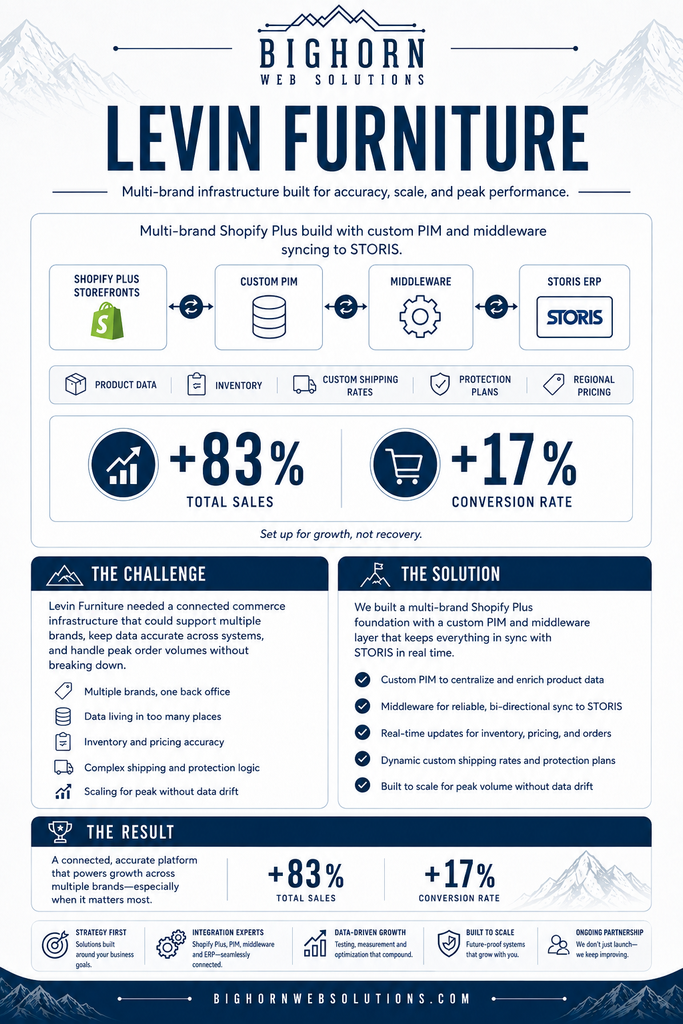
Levin Furniture. Multi-brand Shopify Plus build with custom PIM and middleware syncing to STORIS. Product data, inventory, custom shipping rates, protection plans, and regional pricing all move dynamically between the storefront and the back office across multiple brands. The systems were built to keep that data accurate as volume scales, which is exactly what a multi-brand operation needs when order rates climb during peak. Total sales are up 83% and conversion is up 17%.
The same principle applies to any operation heading into its biggest weeks. The brands that stay standing under peak load are the ones whose inventory sync, ERP integration, and promotion logic were pressure-tested before the season, not during it. The work that protects a peak weekend happens in the quiet months before it.
Where to Start
Peak season rewards the teams that pressure-tested the whole operation instead of just the storefront. The cracks that cost the most are findable ahead of time, sitting in the inventory sync, the ERP integration, and the promotion logic that only get tested at true volume once the season arrives. Finding them in a quiet month is a planning exercise. Finding them on the biggest sale day is a crisis.
If you want a second set of eyes on your operation before peak, we run a 20-minute feedback session that helps you spot the operational risks that surface under load, before they cost you the season.