
Your team is shipping faster than it was a year ago. Theme updates that used to take a week now go out in two days, integration scripts get written in an afternoon, and the backlog moves at a pace leadership has noticed. Part of the reason is that AI is now writing a real share of the code, whether your developers use it directly or your agency does.
The speed is real, and so is the question that comes with it. Some of those changes touched checkout. Some touched the connection between your storefront and your ERP, or the logic that applies discounts across the catalog. Every one of them went live, and you may not know which ones a model drafted, who reviewed them, or how fast anyone would know if one of them failed.
AI belongs in ecommerce development, and the useful part of the conversation is deciding where. Work that’s easy to check and cheap to fix is a good fit for AI. Systems that move money, inventory, and customer data need a different standard, regardless of who or what wrote the first draft.
Here’s what we’ll cover: where AI earns its place in an ecommerce build, where the stakes change, what business-critical systems need no matter how the code gets written, the questions to ask your team or agency, and how Bighorn uses AI on client work.
Where AI Earns Its Place
Plenty of ecommerce development work is a good fit for AI. The pattern that makes it a good fit is simple: a person can check the output quickly, and if something is wrong, the mistake gets caught long before it reaches a customer or touches revenue.
Within that boundary, AI saves real time and lets senior developers spend their hours on the problems that need judgment. A few areas where it consistently pulls its weight:
- Theme and front-end scaffolding. Building out page sections, components, and layout variations gives a developer a solid starting point to refine and review, which cuts days off routine front-end work.
- Repetitive and boilerplate code. Standard patterns the team has written dozens of times come together faster, and a reviewer can confirm they’re correct at a glance.
- Test cases and QA coverage. Drafting test scenarios widens coverage across the site, which makes every other part of the build safer to ship.
- Documentation and data mapping drafts. First passes at field mappings, technical specs, and integration documentation give a senior architect something to validate instead of a blank page.
- Product content and catalog cleanup. Enriching and structuring product data across thousands of SKUs moves much faster with AI, with people spot-checking the results.
What these have in common is a small blast radius. A layout bug shows up in review, a weak test case gets rewritten, and a messy product description gets fixed before anyone buys from it. The team gets the speed without putting orders, payments, or customer data at risk, which is exactly the trade worth making.
Where the Stakes Change
Some parts of an ecommerce build carry consequences the moment they go live. A mistake in these systems costs orders, margin, or customer trust in real time, often before anyone on the team realizes something is wrong.
These are the areas where AI-generated code needs the most scrutiny:
- Checkout and payments. A logic error here loses orders immediately and can open up PCI compliance exposure on top of the lost revenue.
- ERP, OMS, and inventory integrations. Code that moves orders and stock between systems can fail without throwing an obvious error, so the damage shows up days later as oversells, stuck orders, or inventory that no longer matches the warehouse.
- Pricing and promotion logic. One rule that misfires across a full catalog can apply the wrong discount to thousands of products and erode margin before the first complaint comes in.
- Customer data and authentication. Access control mistakes put customer accounts and personal information at risk, which carries legal and reputational costs that outlast any fix.
AI models write code based on patterns, and they have no view of your business rules, your edge cases, or how your promo engine talks to your ERP. Code can look finished, pass a basic test, and still carry a flaw that only someone who knows the system would catch. Independent testing found that nearly half of AI-written code shipped with a security weakness, and on a checkout or payment flow, that kind of weakness becomes a revenue and compliance problem.
What Business-Critical Systems Need, No Matter Who Writes the Code
Checkout, integrations, and pricing logic have always needed a high standard. AI raises the stakes because code now gets written faster than most teams have adjusted their review and testing to handle. The standard for these systems stays the same whether a senior developer or a model wrote the first draft, and it comes down to five requirements.
- Senior review by someone who knows the system. A reviewer who understands how your checkout, ERP, and promo engine connect will catch problems a model has no way to see, because the model doesn’t know your business rules. That review has to come from someone with real context on your stack, since a generic code check only confirms the code runs.
- Testing against real data and real volume. Code that passes in a clean test environment can still break on messy production data, unusual order types, or the traffic of a big sale. Critical changes get tested against the conditions they’ll actually face once they’re live.
- Real-time monitoring and alerting. Failures on critical paths have to surface in minutes. When a sync stops running or checkout errors start climbing, the right person gets alerted right away, so a broken integration costs an hour of orders instead of a full day.
- Architecture built to scale. Faster code changes only help when the foundation underneath can absorb them as order volume, SKU counts, and channels grow. A quick fix layered onto fragile architecture adds risk with every release.
- A tested rollback plan. Every change to a critical system needs a fast, proven way back. When something goes wrong during peak traffic, the team should be able to reverse it in minutes without improvising.
Teams that hold to these five can use AI to move faster without betting the business on it. The speed shows up in development, and the protection stays in place for the systems that run the business.
Questions to Ask Your Team or Agency About AI
You don’t need to be a developer to find out whether AI is being used responsibly on your site. A handful of direct questions will tell you a lot about how your team or agency handles the code that runs your business. These are worth bringing to your next check-in:
- Where in our build are you using AI today? A good partner can answer this specifically, by area of the site and type of work, and is comfortable talking about it.
- Who reviews AI-generated code before it ships, and do they know our systems? Listen for a named person with real context on your checkout, integrations, and business rules.
- How is code tested before it touches checkout, payments, or integrations? The answer should cover real data, realistic volume, and a staging environment that mirrors production.
- How fast would we know if something broke in production, and who gets alerted? Minutes is the right answer for critical paths, with a specific person on the receiving end.
- Who is accountable when a change breaks something that costs revenue? One owner should take responsibility, and it shouldn’t take a long meeting to figure out who.
Specific answers show a team that has thought through how AI fits into its process and where it stops. Vague answers, or answers that only talk about speed, usually mean the risk is real and nobody is tracking it. Either way, the conversation gives you a clearer picture of what’s happening inside your build than any status report will.
How Bighorn Uses AI
Bighorn uses AI where it makes the work faster, and the team is open with clients about where that is. Scaffolding, repetitive code, test coverage, documentation drafts, and catalog cleanup all move faster with AI in the workflow, and that speed goes back to the client as shorter timelines and more time spent on the problems that need judgment.
Every change on a business-critical path is owned by a senior architect. Everyone on the Bighorn team works at senior or architect level, and everyone joins client-facing meetings, so the people reviewing a change to checkout or an ERP integration are the same people who learned how that client’s business runs. Work never gets handed off to a less experienced team after the project kicks off. Monitoring, testing against real conditions, and rollback plans are built into the work from the start, which is a big part of why clients stay with Bighorn for years.
That approach shows up in the kind of work where mistakes are expensive:
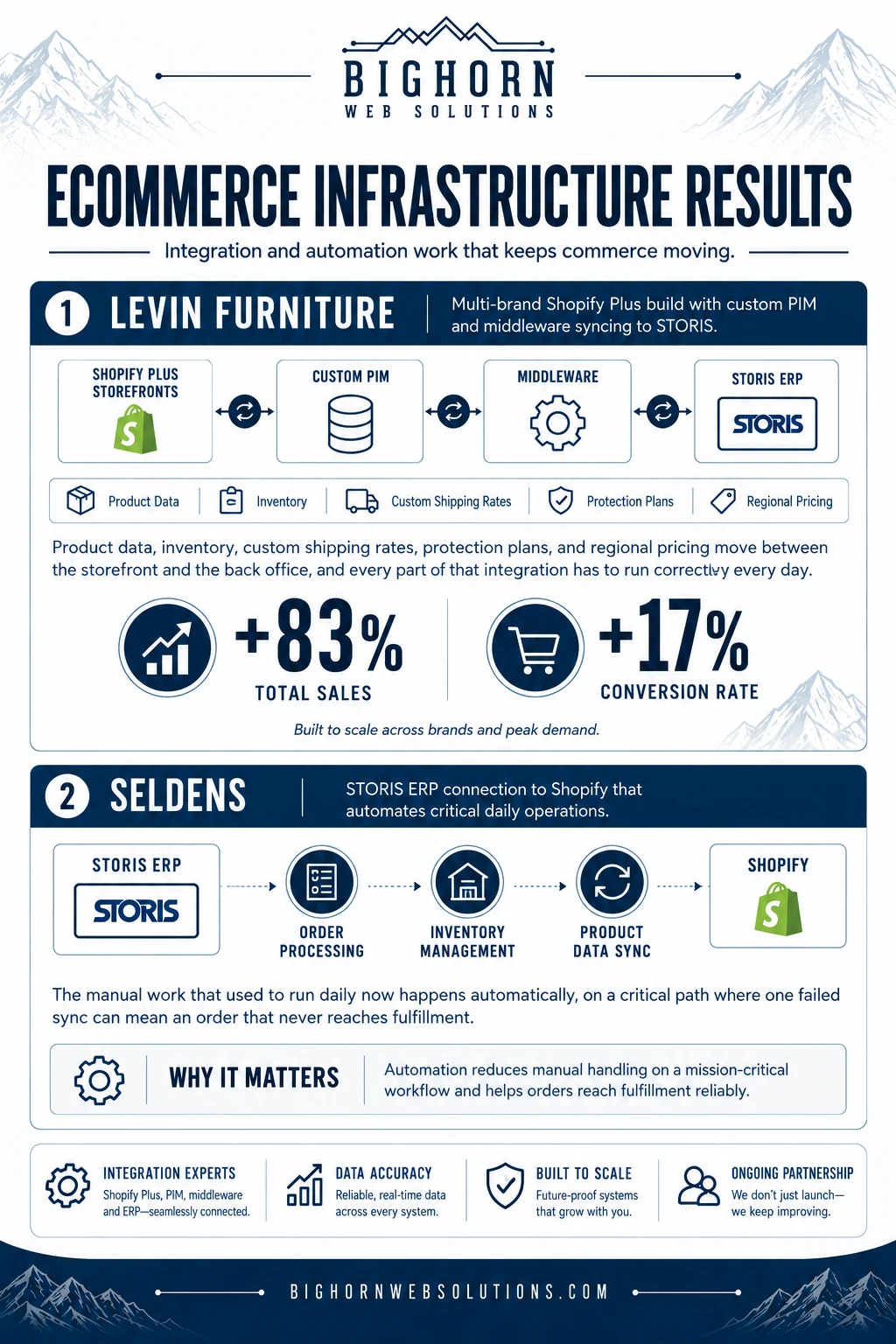
Levin Furniture. A multi-brand Shopify Plus build with custom PIM and middleware syncing to STORIS, the ERP that runs Levin’s operations. Product data, inventory, custom shipping rates, protection plans, and regional pricing all move between the storefront and the back office, and every piece of that integration has to run correctly every day. Total sales are up 83% and conversion is up 17%.
Seldens. A STORIS ERP connection to Shopify that automates order processing, inventory management, and product data sync. The manual work that used to run daily now happens automatically, on a critical path where one failed sync can mean an order that never reaches fulfillment.
Where to Start
AI will keep writing more of the code behind ecommerce sites, and the speed it brings is worth having. The brands that get the most out of it will be the ones that know which parts of their business it should touch, hold critical systems to a higher standard, and have experienced people accountable for anything that moves money, inventory, or customer data.
If you want an outside read on how AI is being used in your build and where the risk sits, we run a 20-minute feedback session that walks through your critical systems and what to tighten first.